
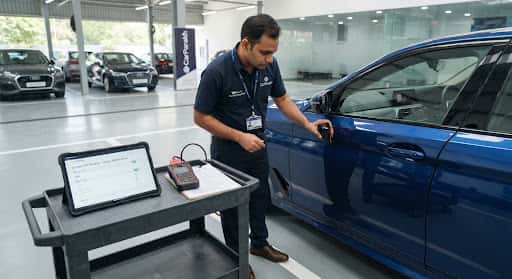
Use good daylight, careful visual checks and suitable diagnostic tools. Interpret paint-gauge readings in the context of the vehicle and panel—not against one universal threshold.
Key Checks Before You Accept Delivery
Prefer to have it done for you? Our new car PDI service covers the full pre-delivery inspection for a new car at the dealership, and we also offer an old car inspection if you're buying second-hand.
Why a New Car PDI Matters Before Delivery
A new car can be moved between the factory, transport yard and dealership before it reaches you. A pre-delivery inspection (PDI) is a buyer-side check of the exact vehicle allotted to you—not just a quick look at a display car. It helps you confirm the vehicle’s visible condition, features, identifiers and promised accessories before you accept handover.
Try to arrange the inspection in good daylight and before signing the delivery acceptance, where the dealership process allows. Registration, finance and delivery steps can vary, so confirm the sequence with the dealer. This guide is practical information, not a statement of legal rights or a substitute for the vehicle maker’s instructions.
- check_circleAsk the dealership to show you the exact allotted car and confirm its model, variant and colour.
- check_circleRequest a clean, well-lit area where all sides of the vehicle can be inspected.
- check_circleKeep your booking confirmation, invoice details and promised-accessories list handy.
- check_circleTake a phone for photographs and note the vehicle’s odometer reading and VIN.
Inspect the exact car allotted to you, record anything that needs attention, and get the dealership’s response in writing before handover.
Exterior, Paint, Glass and Lights
Walk around the vehicle slowly and view each panel from more than one angle. Natural light makes scratches, dents, paint mismatch and uneven panel gaps easier to notice. Check the front and rear bumpers, bonnet, roof, doors, fenders, tailgate and lower edges—not only the panels at eye level.
- check_circleLook for scratches, dents, chips, overspray, colour variation and signs of repair.
- check_circleCompare panel gaps on both sides and check that bumpers, trims and claddings sit evenly.
- check_circleInspect the windscreen, windows and sunroof (if fitted) for cracks, chips and scratches.
- check_circleCheck headlamps, tail lamps, indicators, DRLs, fog lamps, mirrors, cameras and parking sensors.
- check_circleOpen and close every door, the bonnet and the boot; check the latches and rubber seals.
- check_circleCheck wipers, washer jets, number-plate lights and the fuel/charging flap.
A paint-thickness gauge can provide useful supporting evidence when used correctly, but readings vary by manufacturer, panel, material and instrument. Compare like-for-like panels and interpret readings with an experienced inspector. There is no single micron value that proves every panel is original or repainted; many gauges also cannot measure plastic bumpers.
Tyres, Wheels, Underbody and Engine Bay
- check_circleConfirm tyre size and specification against the vehicle or owner’s manual.
- check_circleLook for cuts, bulges, cracks, uneven wear or damage on each tyre.
- check_circleRead the tyre manufacturing code and ask the dealer about any tyre that appears unusually old.
- check_circleInspect alloy wheels or wheel covers for scratches and dents.
- check_circleCheck the spare wheel or puncture-repair kit, jack, wheel spanner and locking-wheel-nut key, where supplied.
- check_circleAsk for tyre pressure to be set to the manufacturer’s recommended cold pressure.
Where a safe inspection view is available, look beneath the vehicle for visible damage, loose underbody covers or fluid leaks. Do not crawl under a vehicle supported only by a jack. In the engine bay, look for obvious leaks, loose connectors, damaged wiring, unsecured components or battery-terminal corrosion. Check fluid levels against the owner’s manual; colour alone is not a reliable diagnosis.
Start the engine—or power on the vehicle as instructed for an EV—and observe the dashboard self-check. Warning lights should behave as described in the owner’s manual. Do not touch high-voltage components or orange cables on an electric vehicle; those checks belong to trained personnel.
Cabin, Electronics and Odometer
Check the cabin in an orderly sequence. Sit in each seat, inspect the upholstery and trim, and operate the controls rather than assuming that every feature works because the screen powers on.
- check_circleInspect seats, headliner, dashboard, door pads and carpets for stains, tears, scratches or dampness.
- check_circleTest seat adjustments, seatbelts, horn, interior lights and steering-wheel controls.
- check_circleOperate all power windows, mirrors, central locking, wipers and washer jets.
- check_circleTest the air conditioner, blower speeds, infotainment, speakers, USB/charging ports and supplied keys.
- check_circleCheck reverse camera, parking sensors and driver-assistance features fitted to your variant.
- check_circleConfirm that warning indicators complete their start-up check as described in the manual.
Record the odometer reading and ask the dealer to explain it if it seems unusual. Factory movement, yard handling and dealership checks can affect the reading, so there is no universal kilometre cut-off that proves a car has been misused. Where available, a diagnostic scan of supported modules can add useful information, but a basic scan may not access every electronic control unit or establish that every system is fault-free.
A short road test may be possible only when the dealership permits it and the vehicle is authorised and insured for the drive. During an approved drive, pay attention to steering, braking, transmission, unusual noises and warning messages.
VIN, Documents and Accessories
The vehicle identification number (VIN) and other identifiers should match the paperwork supplied for your car. VIN locations differ by make and model, so use the owner’s manual or manufacturer guidance to locate the physical markings rather than relying on one universal location.
Photograph the odometer, VIN plate and vehicle condition on the day of handover. Keep copies of the documents, accessory list and any written commitments from the dealership.
What to Do If You Find an Issue
Do not rely on a verbal assurance for a defect or missing item. Show the issue to the dealership representative and make a clear record before completing handover.
- check_circleTake clear photographs or a short video and note the affected panel, part or feature.
- check_circleAsk the dealership to acknowledge the observation in writing.
- check_circleRequest the proposed resolution and expected completion date in writing.
- check_circleFor a major concern, warning light, leak, suspected repair or safety-related defect, pause handover and seek a clear technical assessment.
- check_circleRe-inspect the vehicle after the work is completed and retain the updated record.
A careful PDI is not about rejecting a car over every minor observation. It is about knowing the vehicle’s condition, getting discrepancies addressed clearly and accepting delivery with the relevant records in hand.
Explore more car PDI services and model checklists
Our inspection services
New and old car PDI guides by model
- Mahindra: Scorpio-N, XUV700, Thar Roxx
- Hyundai and Kia: Hyundai Creta, Kia Seltos
- Tata: Nexon, Punch
- Maruti Suzuki: Brezza, Fronx, Grand Vitara
- Buying second-hand: Used car PDI checklist